Introduction The response of a reinforced concrete structure is determined in part by the material response of the plain concrete of which it is composed. Thus, analysis and prediction of structural response to static or dynamic loading requires prediction of concrete response to variable load histories. The fundamental characteristics of concrete behavior are established through experimental testing of plain concrete specimens subjected to specific, relatively simple load histories. Continuum mechanics provides a framework for developing an analytical model that describe these fundamental characteristics. Experimental data provide additional information for refinement and calibration of the analytical model. This paper presents the concrete material model used in this investigation for finite element analysis of reinforced concrete beam-column connections. and also presents the experimental data considered in model development and calibration, and presents several concrete material models that are typical of those proposed in previous investigations. besides discusses the material model implemented in this study. Also this paper presents a comparison of observed and predicted concrete behavior for plain concrete laboratory specimens subjected to several different load histories.
Concrete Material Properties Defined by Experimental Investigation In developing an analytical model to predict material response, consideration of the physical mechanism of behavior may facilitate the development process and simplify the model formulation. The physical mechanisms of response are most evident in the qualitative and quantitative data collected during material testing with simple load histories. However, given the concrete composition and mechanisms of response, there are particular issues that must be considered in assessing the results of an experimental investigation. Standardized tests may be used to define material parameters such as compressive strength, elastic modulus, tensile strength, and fracture energy. Available experimental data describe the response of concrete subjected uniaxial cyclic compression and tensile loading as well as uniaxial reversed-cyclic loading. Experimental testing of plain and reinforced concrete elements may be used to characterize the response of plain concrete subjected to loading in shear. Additionally, data define the stiffness and strength of concrete subjected to multi-dimensional loading. The results of these experimental investigations define a data set that may be used in model development and calibration.
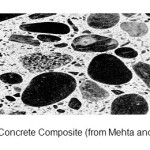
The Composition and Behavior of Plain Concrete Plain concrete is a non-homogeneous mixture of coarse aggregate, sand and hydrated cement paste (see Figure 2.1).For normal-weight, normal-scale concrete mixes, coarse aggregate is usually gravel or crushed rock that is larger than 4.75 mm (0.187 in.) in diameter while sand is aggregate particles with diameters between 4.75 mm and 0.75 mm (0.187 in. and 0.029 in). Hydrated cement paste (
hcp) refers to the hydration product of portland cement and water. The transition zone refers to the
hcp located in the immediate vicinity of the coarse aggregate particles. Because the transition zone typically has a slightly higher water to cement ratio than is observed in the entire
hcp and because of the physical boundary between the different materials, the transition zone is weaker than the remainder of the
hcp.
The initiation and propagation of cracks is the dominant mechanism of concrete material response. Under moderate general loading, the response of the concrete mixture is controlled by microcracking in the transition zone between the aggregate and the
hcp.Under increased loading, microcracks in the transition zone grow and merge and microcracks initiate in the
hcp. Eventually, a continuous crack system forms that traverses the transition zone and the
hcp, resulting in the loss of load capacity. Under compression type loading, the continuous crack system may include cracks that transverse the coarse aggregate. Under tensile loading, increased load acts directly to increase the stress at the crack tip and drive crack propagation. As a result, for tensile loading, the sequence of cracking leading up to the development of a continuous crack system and loss of strength occurs very rapidly. Increased compressive loading indirectly increases stress at the crack tip,driving crack propagation at a much slower rate. For compressive loading, the stages of crack initiation and propagation are readily identified in the observed concrete response, and loss of load capacity occurs more slowly.
Consideration of the Analytical Model Given that concrete is a non-homogeneous composite and that the primary mechanism of response is the development and propogation of discrete cracks, it is necessary to consider the general framework of the model in establishing the experimental data set. The response of plain concrete can be modeled at the scale of the coarse aggregate with the model explicitly accounting for the response of the aggregate, the
hcp and the transition zone material as independent elements or as components of a composite [see Ortiz and Popov, 1982]. However, while there may be available experimental data that defines the response of aggregate and
hcp to general loading, characterization of the transition zone must be accomplished indirectly. Further, the random nature of the component material properties and distribution adds complexity to models that are developed at this scale. In modeling the response of a reinforced concrete structural element, it is reasonable to incorporate both the microscopic response as well as the random nature of the concrete into a macromodel. The macromodel describes the response of a body of concrete that is many times the size of individual pieces of aggregate or of continuous zones of
hcp. It is assumed that initially the concrete within the body is homogenous and that the material response of the components is represented in the global response of the concrete composite. For this investigation, plain concrete is idealized as an initially homogenous material. The idealization of concrete as a homogeneous body requires additional consideration for the case of concrete subjected to moderate through severe loading. At these load levels, the response of concrete is determined by the formation of continuous crack systems. Some researchers have proposed models in which the idealization of concrete as a continuum is abandoned in the vicinity of a the crack, and crack systems are modeled discretely [
e.g., Ayari and Saouma, 1990; Yao and Murray, 1993]. Development and calibration of such a model requires experimental data defining the rate of crack propagation under variable stress states and load histories. Currently, there are few data available characterizing the concrete fracture process under multi-dimensional stress states. Additionally, such a model requires special consideration within the framework of a finite element program. Other researchers have shown that it is possible to maintain the idealization of concrete as a continuum in the presence of discrete cracks. In these models, the material damage (evident in reduced material strength and stiffness) associated with discrete crack ing is distributed over a continuous volume of the material. Such models include the fictitious-crack model [Hillerborg
et al., 1976], smeared-crack models [de Borst et al.,1984], and the crack-band model [Bazant
et al., 1983]. Modeling of concrete as a continuum results in a model that is compatible with many existing computer codes as well as provides a basis for application of existing continuum constitutive theory in developing models. For these reasons, in this investigation concrete is considered to be a continuum. Modeling concrete as an initially homogeneous material and assuming that the discrete cracking is incorporated into a continuum model of concrete, it is necessary that the experimental data set on which the analytical model will be developed and calibrated be compiled from investigations that meet several criteria. The concrete specimens must have critical zones that are sufficiently large that the concrete composite in the vicinity is approximately a homogenous mixture. For load cases in which the material response is determined by a global mechanism (
e.g., microcracking) experimental measurement must define the deformation of the entire concrete body to ensure that the deformation is representative of the composite. For load cases in which the material response is determined by a local mechanism (
e.g., formation of a continuous crack surface), it is necessary that experimental measurement define the global deformation of the concrete body as well as the deformation associated with the localized mechanism. This allows for appropriate calibration of the continuum model.
Concrete Material Parameters Defined through Standardized Testing The prolific use of concrete in the construction industry has led to the development of a series of standardized testing procedures for determining concrete material properties. A concrete material model may be calibrated on the basis of material parameters determined using these standard procedures. The response of a reinforced concrete structural element is determined in part by the response of plain concrete in compression. As a result, standard practice in the United States [ACI, 1992] recommends characterizing the response of concrete on the basis of the compressive strength of a 6 inch diameter by 12 inch long (150 mm by 310 mm) concrete cylinder. For typical concrete mixes, the standard cylinder is sufficiently large that the material is essentially homogeneous over the critical zone. Additionally, while the standard procedure (ASTM C39) does not require efforts to reduce frictional confinement induced during testing at the ends of the specimen, the specimen is considered to sufficiently long that approximately the middle third of the cylinder experiences pure compression. Thus, this method is appropriate for determining the uniaxial, compressive strength of concrete. Following from the test for compressive strength, ASTM C469 establishes a procedure for determining concrete elastic modulus. This method requires loading of the standard cylinder in uniaxial, cyclic compression at relatively low load levels. Some researchers have suggested that the
elastic modulus for concrete may be different under compression and tension type loading. While it is possible that differences in microcrack patterns and distribution may affect material stiffness under compression and tension loading,it is likely that some difference in concrete response under compression and tension loading is due to the difference in boundary conditions under variable loading. For this investigation, concrete elastic material response, in tension and compression, is defined by a single set of material parameters established by standard material testing. In the absence of experimental data, the concrete elastic modulus may be estimated on the basis of the compression strength:

where
Ec is the elastic modulus (psi),
wc is the weight density of the concrete (lb/ft3) and
fc is the compressive strength (psi) (ACI Committee 363., 1992). Poisson’s ratio characterizes the elastic response of concrete. Poisson’s ratio can be determined experimentally by measuring the radial or circumferential expansion of a standard concrete cylinder subjected to compression loading. ASTM C469 establishes a standardize procedure for determination of Poisson’s ratio from compression testing of standard cylinders. Most research suggests that Poisson’s ratio for concrete is between 0.15 and 0.20 [
e.g., Mehta and Monteiro, 1993] and that there is little correlation between Poisson’s ratio and other material properties. (Mehta et al.,1993) suggest that Poisson’s ratio is generally lower with high strength concrete and lower for saturated and dynamically tested concrete. However, Klink [1985] proposes, on the basis of extensive experimental testing, that an average value of Poisson’s ratio appropriately is estimated on the basis of concrete compressive strength:

where ï®
c is the elastic Poisson’s ratio,
wc is the unit weight of the concrete (lb/ft3) and
fc is the compressive strength (psi). The value of Poisson’s ratio predicted by Equation (2-2) varies between 0.16 and 0.20 for normal-weight, average-strength concrete. Given the observed variation in concrete composition and in experimental data, in the absence of experimental data a value of Poisson’s ratio between 0.15 and 0.20 is appropriate for characterizing elastic material response.
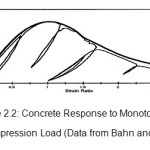
Concrete Subjected to Uniaxial Compression The complete stress-strain history for concrete subjected to uniaxial compression provides data for use in characterizing the response of concrete to general loading. Figure 2.2 shows a plot of the stress-strain response of a typical concrete mix subjected to monotonically increasing compressive strain. Important characteristics of this response include the following outlined by (Mehta et al., 1993] (see Figure 2.2)
- The response of the plain concrete under increasing strain is essentially linear-elastic until the load reaches approximately 30 percent of the peak compressive strength (Zone A). This linear-elastic response corresponds to minimal, stable crack growth within the transition zone. Note that a stable crack does not continue to grow under constant load.
- Loading to compressive stress between 30 and 50 percent of peak compressive stress, results in some reduced material stiffness (Zone B). Reduction in the mate- rial stiffness results from a significant increase in crack initiation and growth in the transition zone. Crack growth is stable.
- Loading to compressive stress between 50 and 75 percent of peak compressive stress results in further reduction in material stiffness (Zone C). Here the reduced stiffness is partly a result of crack initiation and growth in the hcp. Additionally,reduced material stiffness results from the development of unstable cracks that continue to grow when subjected to a constant load.
- Concrete loaded to more that 75 percent of the peak compressive load responds with increased compressive strain under constant loading (Zone D). This results from spontaneous crack growth in the transition zone and hcp and well as from the consolidation of microcracks into continuous crack systems.
- Loading to compressive strains beyond that corresponding to the compressive strength results in reduced compressive strength (Zone E). This response is a result of the development of multiple continuous crack systems.
For model development, this behavior may be simplified into three levels of response. Concrete initially responds as an elastic material. Under increased loading, global microcracking results in reduced material stiffness. Eventually, further increase in compressive strain demand results in the development of multiple continuous crack systems and reduced strength. Figure 2.2 also shows the typical response of plain concrete subjected to uniaxial, cyclic compression loading. Important characteristics of this response include the following:
- Under increasing compressive strain, the stress developed follows the monotonic stress-strain response.
- At moderate strain levels, the stiffness of the unload-reload cycles is approximately equal to the elastic modulus; however, the stiffness deteriorates with increased strain demand.
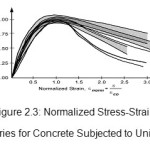
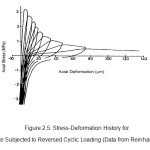
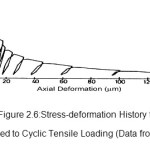
Figure 2.3 shows the normalized stress-strain response for a number of plain concrete specimens subjected to monotonic loading. Figure 2.5 and Figure 2.4 show similar data for concrete subjected to cyclic loading. Previous research suggests that the post-peak compressive stress-strain response is dependent on specimen height, implying that compression failure is a localized phenomenon(van Mier., 1986). The data presented in Figure 2.3 are for specimens with gage lengths that vary from 3.5 inches to 6.5 inches and this accounts somewhat for the variability of the results. The data presented in Figure 2.5 show the response of plain concrete prisms (3.0 by 5.0 by 6.5 inches) subjected to cyclic compression loading. For this configuration, it was found that peak compressive strength was approximately 85 percent of that determined using the standard compression tests. While this test program does not predict the compression strength as defined by the standardized test procedure, the results are representative of concrete subjected to cyclic compression loading.
Concrete Subjected to Shear Plain concrete subjected to monotonically increasing shear will exhibit tensile cracking perpendicular to the orientation of the principal tensile stress. In this case, material behavior may be predicted on the basis of the established concrete response to tensile loading. This implies that shear load and material response most appropriately is modeled on the basis of the combined compression and tension stress state.
Concrete Subjected to Multi-Dimensional Loading Since plain concrete in a reinforced concrete element is subjected to multi-dimensional loading, it is not sufficient to develop a constitutive model for concrete that is calibrated solely on the basis of the uniaxial response. A number of researchers have investigated the response of concrete subjected to two- and three-dimensional loading. Results of these investigations include analytical models characterizing the multi-dimensional compressive yield/failure surface and the evolution of this yield surface under increased loading as well as experimental data defining the concrete strain history under multi-axial loading.
Damage Theory Applied to Modeling Concrete Behavior The defining characteristic of material damage is reduced material stiffness. Experimental data exhibit material damage for concrete subjected to tensile loading, and to a lesser extent, compressive loading (see Figures 2.2 and 2.8). Thus, it is appropriate to incorporate material damage into models characterizing the response of plain concrete to variable loading. Continuum damage mechanics provides a means of modeling at the macroscopic level the material damage that occurs at the microscopic level. Development of a damage-based model requires definition of a damage rule that characterizes the rate at which material damage is accumulated and the orientation of the damage. Definition of this damage rule may also include definition of a damage surface that defines an initial elastic domain. Various proposed damage models differ in the definition of the damage surface and damage rules. Some of the first constitutive relationships for damaging materials proposed isotropic damage rules. One such model is that proposed by Lemaitre [1986]. This model follows from the assumption that one can define an effective stress that is larger than the Cauchy stress and accounts for the reduction in material area that results from micro cracking:

where is the effective stress and
D is the positive scalar measure of material damage. A second assumption follows that the material strain is a function of the effective stress. The contribution of damage to the thermodynamic potential for free energy in the system is explicitly defined:

and from which can be defined an internal variable associated with the damage state. Ultimately, a damage rule is proposed in which the rate of accumulated damage, D is a power function of the stress state. (Chaboche.,1988) proposes a very similar model in which the rate of accumulated damage is an explicit function of the strain state. These models can be calibrated to characterize the response of concrete subjected to uniaxial, cyclic loading However, these models imply that severe loading along one axis results in reduced material resistance to loading in any direction. Data collected during testing of reinforced concrete components indicate that this is not the most appropriate model for concrete subjected to multi-dimensional cyclic loading. Additionally, these models imply that dam- age is accumulated immediately upon loading, an assumption that is not supported by material testing.
Elastic-Plastic-Damage Models for Concrete Response Given that concrete displays the characteristics of both a plastic material and a damaging material, it is appropriate to develop models that incorporate both mechanisms of response. In recent years, two types of elastic-plastic-damage models have been proposed. Several of these models are developed on the basis of plasticity theory and the assumption that material damage appropriately is defined by the accumulated plastic strain (Frantziskonis
et al., 1987); (Lubliner
et al., 1989). The model proposed by (Lubliner
et al. 1989) has the following characteristics:
- The shape of the yield surface is assumed to remain constant and is defined by a modified Mohr-Coulomb criterion.
- The evolution of the elastic domain is defined by a hardening rule that is calibrated on the basis of experimental data.
- Plastic strain is defined on the basis of an associated flow rule.
- Damage is assumed to be isotropic and defined by a single scalar damage variable,ï«, that is a measure of the accumulated damage.
- Damage is assumed to accumulated as a function of plastic strain:

are the hardening functions for concrete response in tension and compression;
gt is the concrete fracture toughness;
gc is a material parameter analogous to
gt but defined for compression response, and is a weighting function that characterizes the response as tensile or compressive in nature. This models follows from the assumption that damage accumulated as a result of post-peak tensile loading will reduce concrete stiffness in compression; however, experimental testing of reinforced concrete elements under reversed cyclic loading indicates that this is not an appropriate assumption. This issue has been addressed by (Lee
et al.,1994)through the introduction of multiple damage parameters that defined concrete damage under predominantly compressive loading and predominantly tensile loading independently. For a second class of elastic-plastic-damage elements, the damage and plasticity mechanism of response are independent. For these models, it is appropriate to consider the elastic domain to be bounded by the damage surfaces and the plasticity surfaces. One such model is that proposed by (Govindjee et al.,1997). This model considers a damage model to characterize the response of concrete in tension and shear and a plastic model to characterize the response of concrete in compression. Additionally, this model has the following characteristics: Anisotropic damage model with the orientation of damage established by formation of a single fixed fictitious crack surface that is perpendicular to the direction of the peak principal tensile stress.
- The damage/failure surface defines an undamaged concrete tensile strength and shear strength; damage initiates when the trial principal tensile strength exceeds the concrete tensile strength.
- The damage surface has an exponential softening rule with accumulated damage occurring through tensile and shear action on the fictitious crack surface.
- Single surface plasticity model with associated plastic flow.
Characterization of the Response of Plain Concrete in Reinforced Concrete Beam-Column Bridge Joints The experimental data presented in the preceding sections define the response of concrete subjected to variable loading. The previously discussed constitutive models provide a foundation for development of a model that characterizes the response of plain concrete. This information can be combined to develop a model that characterizes the modes of response exhibited by plain concrete in reinforced concrete beam-column bridge joints.
Definition of the Concrete Constitutive Model The model developed to characterize the response of concrete for this investigation is an extension of the models previously proposed by (Govindjee
et al.,1995) and (Govindjee and Hall.,1997). The formulation presented here provides for the formation of multiple fictitious crack surfaces, accounts for crack opening and closing, represents the response of concrete subjected to multi-dimensional loading in compression and predicts the response of concrete subjected to predominantly biaxial loading. The model considers a body in three-dimensional space, Ωε
ℜ composed entirely of the material considered here. Assuming that it is appropriate to model the material as a homogeneous continuum, each point in the body is assumed to obey the following relationship: σ = C: (ε-ε
p) where , and
p are rank two stress tensors representing the Cauchy stress, the total strain and the plastic strain and C is the rank four tensor representing the material stiffness.
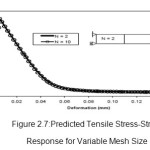
Conclusions The concrete constitutive model proposed for use in this investigation characterizes the observed response of plain concrete in reinforced concrete beam-column bridge joints subjected to earthquake loading. Plain concrete is modeled as a continuum, and plasticity theory and damage theory are employed to develop an analytical model that characterizes the response of plain concrete subjected to variable load histories. The result of experimental testing of reinforced concrete structural elements are used as a basis for further refinement of the model. Variability in concrete material response within individual experimental investigations and between studies requires that an appropriate analytical model predict the fundamental characteristic of the material response rather than the results of a particular investigation. Comparison of predicted and observed concrete response shows that the model proposed for this investigation characterizes the response of plain concrete within the appropriate range of loading for concrete composing reinforced concrete bridge frames. The model incorporates the characteristic length technique to ensure that the results are independent of mesh size.
References
- Ju, J.W. On energy based coupled elasto-plastic damage theories: Constitutive modelling and computational aspects, Int. J. Solids and Struct., 25(1989)803-833.
- ACI Committee 363, State-of-the-Art report on high-strength concrete, ACI. J.,81(1984)364-411.
- Candappa, D.C. Sanjayan, J.G. and Setunge, S., Complete stress-strain curves of highstrength concrete, J. Mat. Civil Engrg., ASCE, 13(2001)209-215.
- Kmita, A. A new generation of concrete in civil engineering, Mat. Processing Tech., 106(2000)80-86.
- Buyukozturk, O. and Shareef, S.S. Constitutive modelling of concrete in finite element analysis, Computers and Structures, 21(1985)581-610.
- Chen, W.F. Plasticity in Reinforced Concrete, McGraw-Hill Book Company, 1982.
- Bouzaiene, A. and Massicotte, B. Hypoelastic tridimensional model for nonproportional loading of plain concrete, Engrg. Mech., ASCE, 123(1997)1111-1120.
- Chen, W.F. Constitutive Equations for Engineering Materials, Vol. 1: Elasticity and Modelling, Elsevier Publications, 1994.
- Popovics, S. A review of stress-strain relationships for concrete, ACI J., 67(1970)243-248.
- Shah, S.P. Strain softening stress-strain relations for concrete, Mech. Engrg. Mat.,Edited by C.S. Desai and R.H. Gallagher, John Wiley & Sons, 1984(579-590).
- Desayi, P. and Krishnan, S., Equation for the stress-strain curve of concrete, ACI J., 61(1964)345-350.
- Sanez, L.P. Discussion of ’Equation for the stress-strain curve of concrete’ by Desayi and Krishnan, J. Proc., 61(1964)1229-1235.
- Smith, G.M. and Young, L.E. Ultimate flexural analysis based on stress-strain curves of cylinders, ACI J., 53(1956)597-610.
- Attard, M.M. and Setunge, S. Stress-strain relationship of confined and unconfined
- Richard, R.M. and Abbott, B.J. Versatile elastic-plastic stress-strain formula, Engrg. Mech., ASCE, 101(1975)511-515.
- Carreira. D.J. Chu, Kuang-Han, Stress-strain relationship for reinforced concrete in tension, ACI. J. 84(1986)21-28.


![Figure 2.4: Stress-Strain History for Concrete Subjected to Compression Loading (Data from Bahn and Hsu.,1998), Karson and Jirsa.,1969), Kosaka et al.,1984]) and Sinha et al.,1964)](http://www.cwejournal.org/wp-content/uploads/2015/05/Vol10_Spe_struc_MEHDI_Fig41-150x150.jpg)

 Views:
 PDF Downloads: